You rebuilt your whole digital filing system at 2 a.m. but can't answer one email. If that's laziness, it's a very strange kind.
The 30-second version
ADHD brains run low on available dopamine — the chemical that makes starting and persisting feel rewarding. So motivation follows interest, novelty, challenge, and urgency instead of importance. You're not lazy; your fuel system is different. The fix is designing tasks (and days) that supply the fuel on purpose.
Most people can rev their engine with importance: "this matters, so I'll do it." ADHD brains largely can't. Our engines turn over for interest, novelty, a friendly challenge, or a deadline that's close enough to smell. That's why you can research a hobby for six straight hours and stall on a five-minute form: the form offers your brain almost nothing to grab onto.
This is also why last-minute pressure "works" — urgency manufactures the chemical push that importance couldn't. It works, but it bills you in stress. The goal isn't to live on emergency fuel; it's to add interest and novelty earlier, on purpose, in doses that don't hurt.
Lazy people are unbothered. They rest comfortably and don't think about the task again. You, on the other hand, have probably thought about the undone thing forty times today, felt the guilt each time, and still couldn't get your body to start. That gap — caring deeply and still not starting — is the signature of a regulation problem, not an attitude problem.
Words shape what we try next. "I'm lazy" suggests the cure is more self-criticism. "My brain needs a different on-ramp" suggests timers, company, music, smaller first steps — things that actually work. Choose the story that leads somewhere.
A dopamine menu is a pre-written list of small, genuinely enjoyable activities, sorted by effort — appetizers (a song, sunlight, stretching), mains (a walk, a call with a friend, a hobby sprint), and desserts for the really flat days. When your brain is running on fumes, you don't have to invent motivation; you pick from the menu.
Use it as an on-ramp: five minutes of appetizer, then the tiniest first step of the task while the engine's warm. And schedule menu items into boring days before you need rescuing. Brains, like phones, work better when you don't let them hit 1%.
The done-for-you version
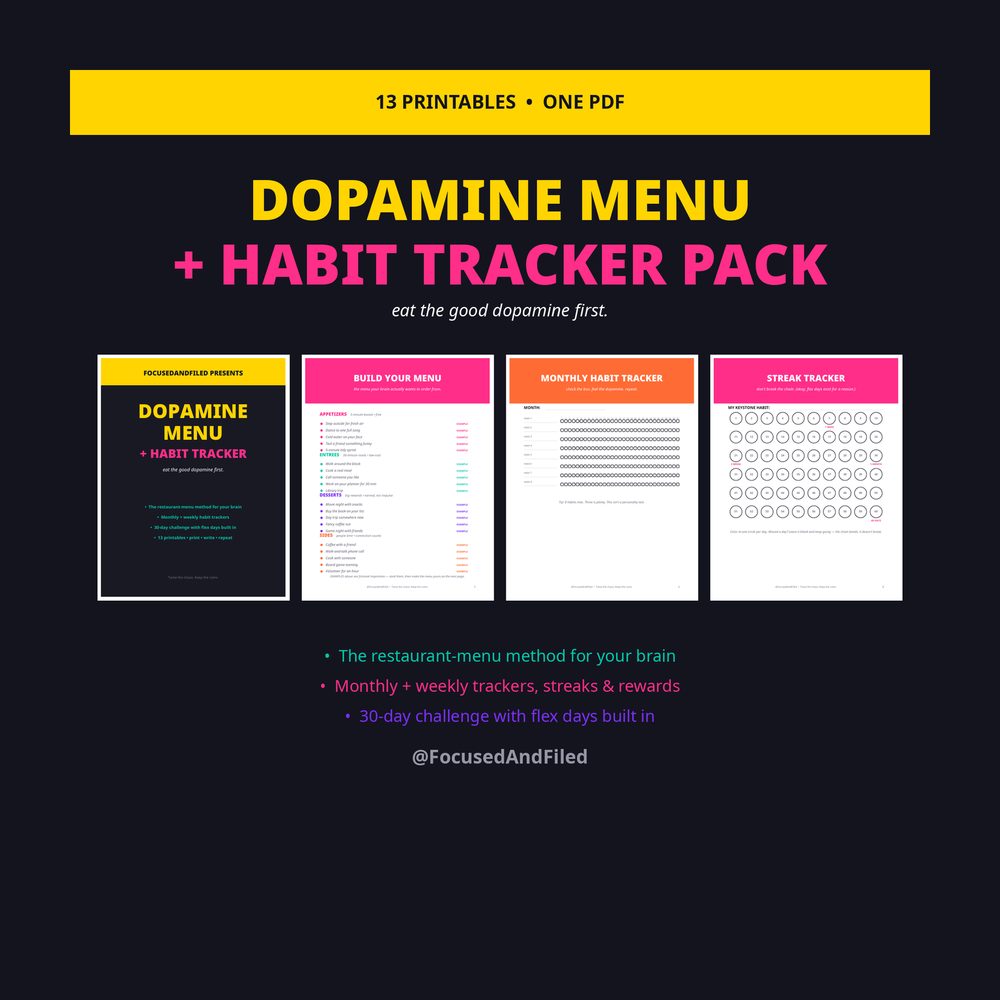
The printable version of this guide: a build-your-own dopamine menu plus a habit tracker gentle enough for brains that abandon trackers.